
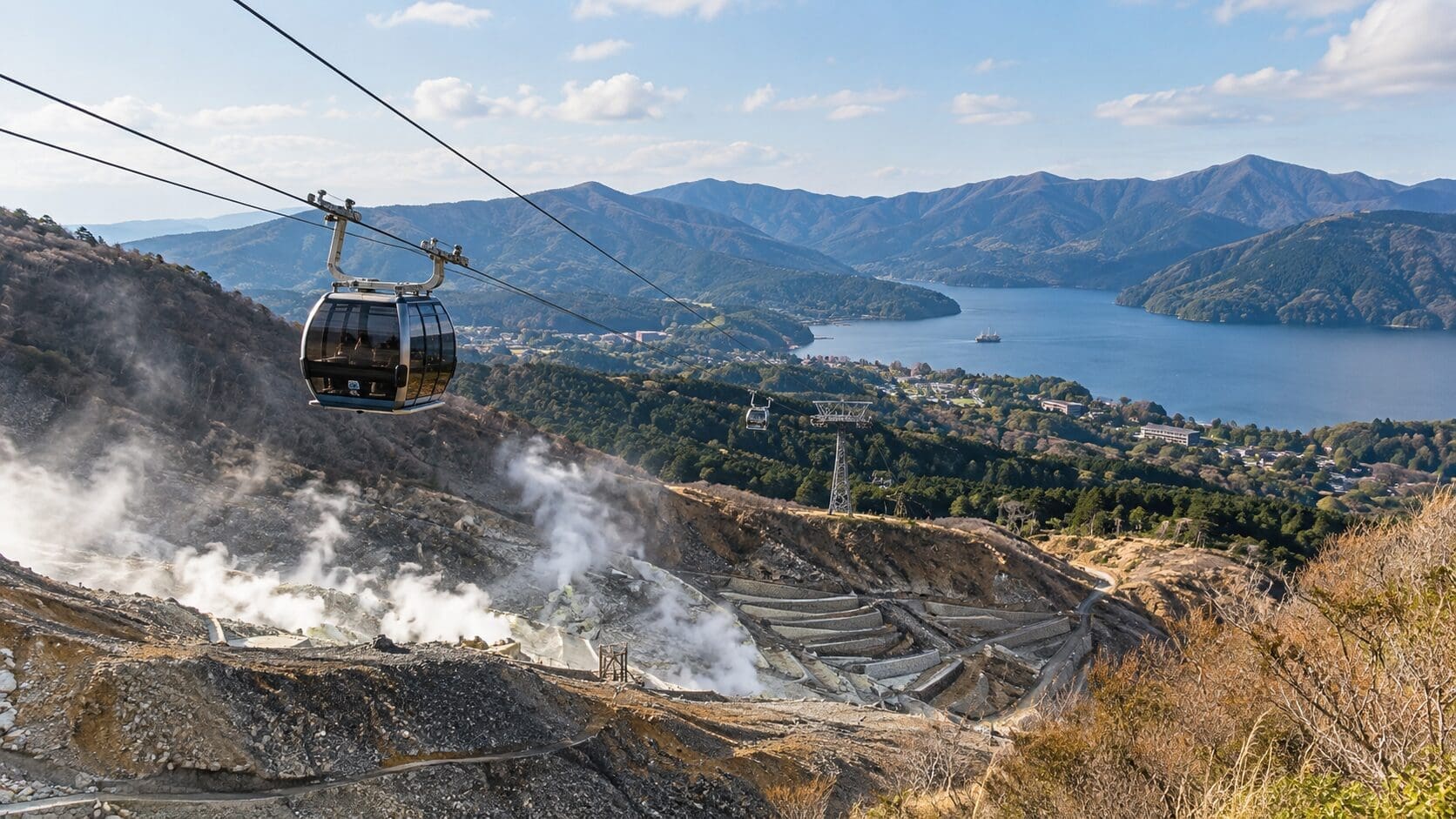
Hakone is close enough to Tokyo for a day trip, but the classic circuit is not a single attraction. It is a chain of trains, cable car, ropeway, cruise, and buses, with queues and weather affecting the order. A day trip works when the loop itself is the priority and you can leave early. An overnight is better when a ryokan meal, onsen, or slower family pace is part of the reason for going.
The simplest decision is this: choose one day for movement and highlights; choose one night when you want Hakone to feel like a stay rather than a transport challenge.
Quick decision matrix
| Format | Start-time demand | Transfer burden | Best luggage plan | Disruption tolerance | Best fit | Main sacrifice |
|---|---|---|---|---|---|---|
| Guided day tour | Fixed early meeting | Low navigation burden, but still a long day on public transport | Store or forward large bags before meeting | Guide manages changes, but closures can still alter the route | First-time visitors who value guidance over flexibility | Highest cost and least control over pace |
| DIY loop day trip | Leave Shinjuku around 07:30 or reach Hakone-Yumoto early | High: repeated boarding plus walking and queues | Carry only a day bag; use station storage | Moderate if you are willing to cut stops | Confident planners who enjoy varied transport | Museums, long meals, and onsen compete for limited time |
| One-night ryokan stay | Flexible | Spread across two days | Use same-day station-to-hotel delivery where eligible | High: closed links can move to the next day | Couples, families, and travelers prioritizing onsen or dinner | Higher lodging cost and a fixed meal/check-in schedule |
| Tokyo–Hakone–Kyoto/Osaka stop | Early arrival plus a protected westbound connection | High, with an added Odawara transfer | Forward the main suitcase to Kansai; carry one overnight bag | Low if the Shinkansen is booked too tightly | Travelers already moving west | Requires disciplined timing and separate rail planning |
Four realistic Hakone formats
Guided day tour
Odakyu's English-language Hakone CHECKBOX TOUR is currently advertised as an approximately ten-hour full-loop day with an English-speaking guide. The Shinjuku plan includes the Romancecar, a private Hakone Ropeway gondola, a special-cabin Lake Ashi cruise, and the Hakone Open-Air Museum.
As checked September 21, 2026, the regular Shinjuku departure price is ¥27,300 per person. A launch price of ¥23,205 is advertised for bookings made by October 30, 2026 JST. That promotion is time-sensitive and should not be assumed later. The operator also says the tour uses public transport, includes substantial walking, and is not recommended for wheelchair or stroller users.
Choose the guided format when avoiding navigation is worth far more to you than changing the plan spontaneously. Recheck the price, meeting point, inclusions, accessibility, and weather policy before purchase.
DIY loop day trip
A self-guided day is the least expensive flexible option, but only if you edit aggressively. The official one-day example starts at Shinjuku at 07:30, reaches Hakone-Yumoto around 09:20, visits the Open-Air Museum, continues by cable car and ropeway to Owakudani, boards the Lake Ashi cruise around 14:20, visits Hakone Shrine around 15:40, and returns toward Hakone-Yumoto around 17:00.
That is a useful model, not a guaranteed timetable. It shows why a full loop, several museums, a long lunch, an unhurried onsen, and a late Tokyo start do not fit comfortably in the same day. Choose one anchor beyond the transport—often the Open-Air Museum, Owakudani, or Hakone Shrine—and decide in advance which stop you will cut if the day slips.
One-night ryokan stay
Stay overnight when the accommodation is part of the experience. A practical split is Gora and the museum side on one day, then the ropeway, Owakudani, Lake Ashi, and onward travel on the other. That gives weather disruption somewhere to go and removes the pressure to rush back to Tokyo.
Before booking, verify the property's location, meal check-in deadline, children's meals and bedding, station shuttle, bath rules, tattoo policy, and whether the room includes a private bath. Our guides to ryokan versus hotels, private onsen in Japan, and tattoo-friendly onsen near Tokyo help with that decision.
Stop between Tokyo and Kyoto or Osaka
Hakone can work as a westbound stop because Odawara is on the Tokaido Shinkansen. It is not, however, a luggage-friendly loop. Forward the main suitcase from Tokyo to the Kansai hotel and carry what you need for one night.
Use the Odawara-origin Hakone Freepass if the rides justify it, then buy the Shinkansen separately. Do not assume every westbound train stops at Odawara: search the exact date and train through JR Central or SmartEX before setting the Hakone schedule.
What a full loop actually requires
A common clockwise circuit is:
- Odawara to Hakone-Yumoto by train.
- Hakone Tozan Train to Gora.
- Hakone Tozan Cable Car to Sounzan.
- Hakone Ropeway via Owakudani to Togendai.
- Hakone Sightseeing Cruise to Hakonemachi-ko or Motohakone-ko.
- Hakone Tozan Bus back to Hakone-Yumoto or Odawara.
The vehicles are attractions in their own right, but each transfer adds walking and waiting. The official sample takes most of the day even before a leisurely meal or onsen. Families should treat the loop as a full-day outing rather than a short excursion.
When the Hakone Freepass helps—and when to calculate fares
The Hakone Freepass starts at two days, but it can still save money on a one-day full loop. The key is to compare the exact rides, not the number printed on the pass.
Current pass prices
| Origin | 2-day adult | 2-day child | Important exclusion |
|---|---|---|---|
| Shinjuku | ¥7,100 | ¥1,600 | Romancecar reserved-seat supplement is separate: currently ¥1,200 adult or ¥600 child each way to Hakone-Yumoto |
| Odawara, Hakone area only | ¥6,000 | ¥1,500 | Travel between Tokyo and Odawara is separate |
Worked full-loop fare examples
The following adult totals use fares returned by the official Hakone route finder on September 21, 2026. They exclude attraction admission, food, and the Romancecar supplement.
| Example | Individual fares | Pass price | Difference |
|---|---|---|---|
| Shinjuku → Hakone-Yumoto → Gora → Sounzan → Togendai → Motohakone → Hakone-Yumoto → Shinjuku | ¥8,340 | ¥7,100 from Shinjuku | Pass is ¥1,240 lower |
| Odawara → Hakone-Yumoto → Gora → Sounzan → Togendai → Motohakone → Odawara | ¥6,460 | ¥6,000 from Odawara | Pass is ¥460 lower |
The component fares in the Shinjuku example are ¥1,270, ¥460, ¥430, ¥2,000, ¥1,700, ¥1,210, and ¥1,270. The Odawara example replaces the two Tokyo legs with ¥360 from Odawara to Hakone-Yumoto and ¥1,510 from Motohakone to Odawara.
The Freepass is therefore defensible for these full-loop examples and also reduces repeated ticket purchases. It may not be good value for a short visit confined to Hakone-Yumoto, one museum area, or transport already included in a guided tour. Recalculate if your route differs, because fares and operations can change.
Luggage: delivery, storage, or forwarding
Staying overnight in an eligible Hakone hotel
The Hakone Baggage Delivery Service at Hakone-Yumoto currently accepts station-to-hotel bags until 12:00 for same-day delivery to participating accommodation.
| Bag | Limit | One-way price |
|---|---|---|
| Regular | Total dimensions up to 140 cm and up to 15 kg | ¥1,500 |
| Large | Total dimensions up to 200 cm and up to 30 kg | ¥2,500 |
The service does not accept valuables, umbrellas, strollers, glass containers, drinks, computers and other precision equipment, breakables, hazardous items, animals, perishables, or multiple pieces bundled together. It is limited to affiliated hotels.
For hotel-to-station service after checkout, the official page lists collection at Hakone-Yumoto Station between 13:30 and 18:30. Confirm the hotel's handover deadline before relying on it, especially if you have an early westbound train.
Visiting for the day
Temporary storage is available at Hakone-Yumoto for items up to 160 cm in total dimensions and 25 kg. The listed reception window is 09:00–17:30, with pickup by 18:00; prices vary by counter. Odawara's listed reception ends at 16:00, with pickup by 16:30. Those deadlines may be too early for a relaxed loop, so check them against the return plan.
Continuing to Kyoto or Osaka
Forward the large suitcase from Tokyo to the Kansai hotel and keep medication, documents, valuables, chargers, and one overnight set with you. This avoids dragging luggage across repeated transfers and protects the Odawara connection.
Hakone with children, strollers, wheelchairs, or limited walking
Children often enjoy the mountain train, cable car, ropeway, and ship, but repeated boarding and waiting can become the hardest part of the day. Pick one child-friendly anchor, such as the Open-Air Museum, and give the family permission to stop before completing every leg.
A stroller adds friction at transfers, on slopes, and when vehicles are crowded. The full circuit should not be presented as step-free: accessibility varies by station, vehicle, attraction, and accommodation. The official guided tour specifically says its public-transport route and substantial walking make it unsuitable for wheelchair and stroller users. Travelers with specific access needs should plan a reduced-area itinerary and confirm each leg directly.
Ropeway, cruise, weather, and Mount Fuji fallbacks
Mount Fuji is never guaranteed. Build the day around Hakone experiences that still work in cloud.
Check live operations before leaving Tokyo. Hakone Navi publishes separate official alternatives for a cruise closure, a ropeway closure, and both closing together.
- Ropeway closed: follow the current replacement route, cut Owakudani if the substitution consumes too much time, and keep either Gora or Lake Ashi as the day's anchor.
- Cruise closed: use the official bus alternative and avoid wasting time waiting at a closed pier.
- Both closed: abandon the full loop. Concentrate on Gora and the Open-Air Museum, or Hakone-Yumoto and an onsen.
- Roads congested: buses may run late. If a reserved Shinkansen matters, leave the lake earlier and protect the Odawara connection.
If the loop's transfer risk outweighs its appeal, compare our alternatives to Hakone before committing.
Onward travel through Odawara
Odawara is the transfer point for westbound travel, but the Hakone Freepass does not cover the Shinkansen.
- Check the exact Hakone-to-Odawara route and live operating status before leaving the hotel or final attraction.
- Search the exact westbound Shinkansen in the JR Central timetable or SmartEX. Odawara is served by Kodama and selected Hikari services; do not plan around a Nozomi stop.
- Avoid a tight reservation. The official Hakone itinerary warns that evening buses can be delayed by road congestion.
- Collect stored luggage before the counter's closing time—or, preferably, forward the main case to Kansai.
- Keep the Shinkansen ticket separate from the Hakone Freepass and follow the current oversized-baggage rules if carrying a large case.
For booking mechanics, see our guide to buying Shinkansen tickets. If this is part of a first Japan trip, compare the pacing with our realistic 10-day itinerary.
Final recommendation by traveler type
- Choose a guided day if navigation is the main source of stress and the price is acceptable.
- Choose a DIY day if the transport variety is part of the fun and you can start early with only a day bag.
- Choose one night for the best balance of ryokan, onsen, meals, and weather flexibility.
- Choose two nights only if you want hiking, several museums, or a retreat rather than a compact first visit.
- Use Hakone between Tokyo and Kansai only with a separate main-luggage plan and a deliberately protected Odawara connection.
FAQ
Is Hakone worth one day?
Yes, if you start early, carry little, and choose one main stop beyond the transport loop. It is not a relaxed day if you also add several museums, a long meal, and onsen.
Can children do the full loop?
Many can, but repeated transfers and queues are tiring. Choose one child-friendly anchor and be willing to shorten the circuit.
Guided tour or Hakone Freepass?
Choose the guided tour for managed navigation and commentary. Choose the Freepass for flexibility when your planned rides resemble a full loop. Do not buy both automatically; tour transport may already be included.
One night or two?
One night is enough for most first-time visitors and lets you divide the loop. Two nights suit hiking, multiple museums, or a stay centered on the ryokan itself.
Can I continue to Kyoto without returning to Tokyo?
Yes. Return to Odawara and take a westbound Tokaido Shinkansen service that stops there. Check the exact date and train because not every Hikari stops at Odawara, and Nozomi does not.
Where should my luggage go?
For a day trip, use storage only if the pickup deadline fits. For an overnight, use the Hakone-Yumoto delivery service if the hotel participates. For a Tokyo-to-Kansai journey, forward the main suitcase and carry a small overnight bag.
Is Mount Fuji guaranteed?
No. Cloud can hide it even when transport is operating normally. Plan a day that remains worthwhile without the view.
What if the ropeway closes?
Use Hakone Navi's current alternative route and cut at least one stop. If both the ropeway and cruise close, switch to a focused Gora, museum, Hakone-Yumoto, or onsen day instead of forcing the full loop.
CTA: If a transfer-heavy loop does not match your travel style, compare these less complicated alternatives to Hakone.
About the research: This guide is based on current official transport, tour, baggage, and rail information checked September 21, 2026. It does not claim a firsthand Hakone journey.