
Affiliate disclosure: This page contains selected booking links. We may earn a commission from an eligible purchase at no additional cost to you. How affiliate links work.
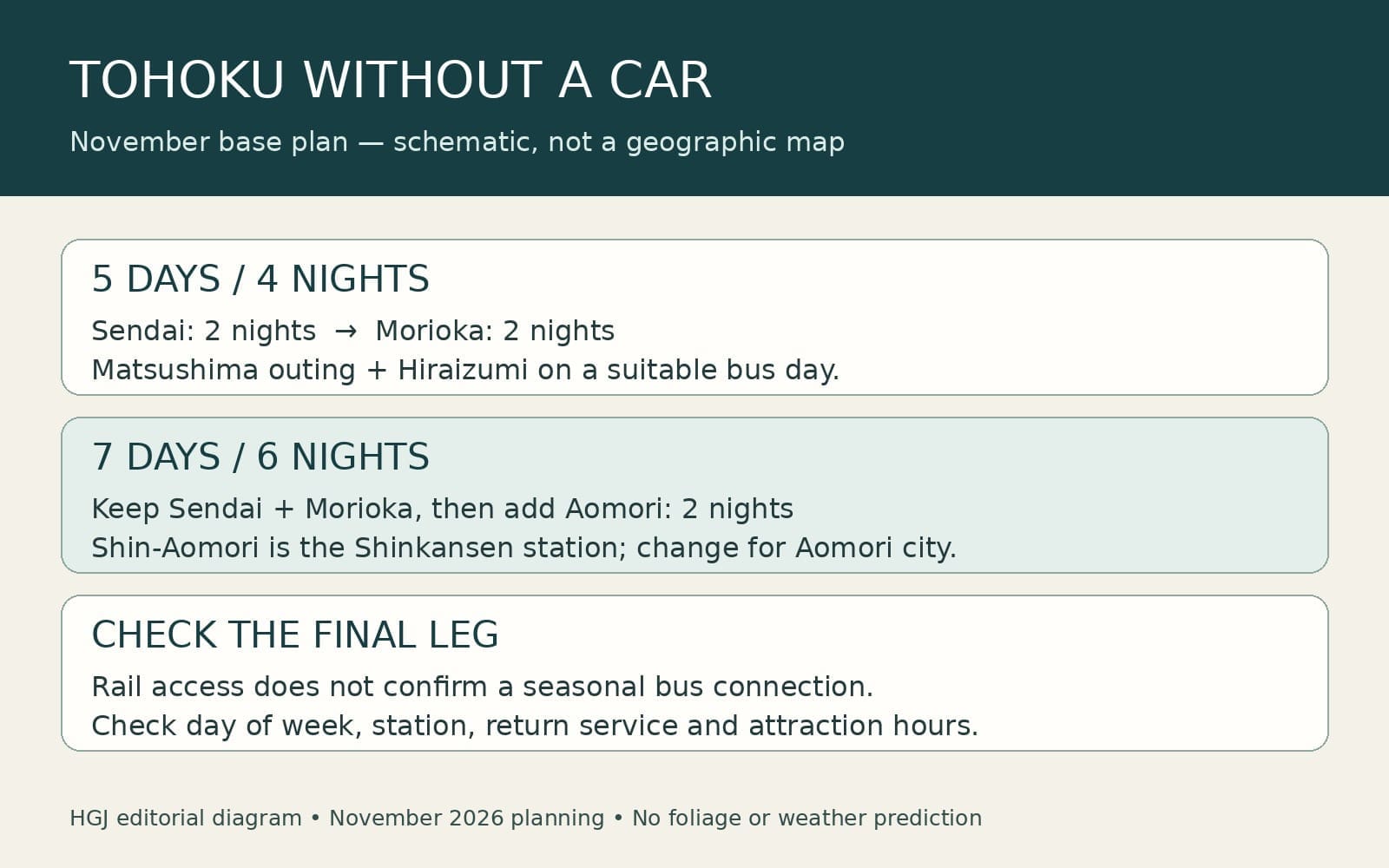
The featured image is an original editorial planning diagram, not a photograph or geographic map.
By Hidden Gems Japan Editorial Team
A November trip through Tohoku works best when you choose the hotel bases first, then check each day trip against its actual operating calendar. Sendai and Morioka make a practical five-day route; seven days allows two additional nights in Aomori.
The important distinction is between a railway station you can reach and the final bus or walk to the place you want to visit. Hiraizumi’s sightseeing bus runs on selected days. Aomori’s November bus change does not apply identically to the Hachinohe approach to Oirase. Getting those details right matters more than collecting destinations.
Quick verdict: follow the rail corridor
Use two nights in Sendai and two in Morioka for five days and four nights. Add two nights near Aomori Station for seven days and six nights.
This guide uses November 12–16, 2026, a Thursday-to-Monday example, extended through Wednesday, November 18. These dates deliberately place Hiraizumi on Sunday and Morioka’s Kogensha on Saturday.
Walking totals and hotel-to-hotel travel blocks are editorial estimates, not measured personal journeys. The Matsushima and Hiraizumi examples below use JR East’s published operating calendars for the stated November dates, checked October 8, 2026. They establish timetable feasibility, not reserved-seat availability or guaranteed operation. Recheck the selected services and reserve Shinkansen seats through JR-EAST Train Reservation when sales open.
November offers city culture, temples and coastal outings, but this itinerary does not depend on a predicted foliage peak or snow conditions.
Choose your bases before your outings
Sendai: stay within a manageable walk of Sendai Station. This simplifies arrival, the Matsushima outing and the move north. Central craft browsing also provides an alternative to spending the entire day outside.
Morioka: a station-area hotel lets you leave your suitcase in your room for Hiraizumi. That is easier than making a temple visit during a hotel transfer and relying on an available station locker.
Aomori: choose the waterfront base around Aomori Station if adding the extension. Shin-Aomori is the Shinkansen station; Aomori is the city station. Allow time for the separate local-train connection.
Five days and four nights: November 12–16, 2026
| Day | Main plan and usable block | Overnight |
|---|---|---|
| Thursday, November 12 | Arrive in Sendai; allow 2–3 hours for central browsing and dinner | Sendai, night 1 |
| Friday, November 13 | Matsushima: roughly 10:00–15:00 at the coast | Sendai, night 2 |
| Saturday, November 14 | Morning train to Morioka; afternoon craft and café visit | Morioka, night 3 |
| Sunday, November 15 | Hiraizumi day trip; aim for 09:30–15:30 locally | Morioka, night 4 |
| Monday, November 16 | Breakfast and departure from Morioka | None |
Thursday: arrive in Sendai without adding a distant outing
If arriving from Tokyo, budget approximately 2½–3 hours from Tokyo Station to your Sendai hotel, including station navigation and the final walk. Replace that estimate with your chosen train and hotel location.
After confirming pre-check-in luggage storage with the hotel, browse central Sendai. Shimanuki’s craft shop in Ichibancho is an option for seeing regional kokeshi and other crafts without traveling to an onsen town.
The city guide lists 10:30–19:00 opening and a second-Wednesday closure. November 12 is Thursday; November’s second Wednesday is November 11. Recheck exceptional closures before visiting.
Allow an estimated 2–3 km of walking for a station-to-Ichibancho outing, browsing and the return. If arrival runs late, have dinner near the hotel and move the shopping to Friday after Matsushima.
Friday: Matsushima from the correct station
Take the JR Senseki Line from Sendai to Matsushima-Kaigan. Allow approximately 60–75 minutes each way, including waiting and walking, rather than treating the train ride as the entire journey.
Matsushima-Kaigan is the convenient station for the waterfront. Matsushima Station, on the Tohoku Main Line, has a different approach and a longer walk to Zuiganji. The tourism association explains both routes.
For Friday, November 13, 2026, JR East publishes local train 831S from Sendai at 09:00 to Matsushima-Kaigan at 09:39. For the return, local train 1584S leaves Matsushima-Kaigan at 15:31 and reaches Sendai at 16:08. Both operating calendars include November 13 at these times. These local trains require no seat reservation; buy the appropriate ticket and check operation before departure.
Visit Zuiganji in the morning, have lunch and choose a short waterfront section. Aim to reach Matsushima-Kaigan around 15:00, leaving time before the return train.
Zuiganji’s November schedule is 08:30–16:00, with final admission at 15:30; morning entry leaves more flexibility. The temple gives a ten-minute walk from Matsushima-Kaigan.
Budget 3–5 km of walking, including temple grounds and waterfront browsing. Reduce that by choosing the temple and one coastal section. If the outing no longer suits your group, stay in Sendai for central shopping and a longer lunch; a boat trip is not necessary for this plan.
Saturday: transfer to Morioka, then visit Kogensha
Take a morning Tohoku Shinkansen from Sendai to Morioka. Set aside an estimated 1½–2 hours hotel to hotel, including checkout, boarding and luggage drop-off. Keep the afternoon free rather than adding another regional excursion.
Visit Kogensha’s main shop and Kahikan café in Zaimokucho. Allow approximately 15–20 minutes to walk there from Morioka Station, then retrace the route to your hotel.
The owner’s calendar specifically lists Monday, November 16 as the November closure. Saturday, November 14 avoids it. Saturday shop closing is 17:30; Kahikan closes at 17:00, with last orders at 16:30. Aim for an early-afternoon visit.
A station–Kogensha outing with nearby browsing means approximately 2–3 km of walking. If the shop closes exceptionally, keep the afternoon for a short city walk and meal near your hotel. Do not transfer this café plan to Monday without checking the calendar.
Sunday: Hiraizumi with a published bus return
For Sunday, November 15, 2026, Hayabusa 104 leaves Morioka at 07:28 and reaches Ichinoseki at 08:09. Change to local train 1531M at 08:55, reaching Hiraizumi at 09:03. This leaves 46 minutes for the transfer and time before the 10:15 sightseeing bus. Both published operating calendars include November 15. Reserve the selected Shinkansen journey when ticket sales open; the local leg is unreserved.
Aim to reach Hiraizumi by about 09:30. The published Runrun timetable supplies this Sunday bus example:
| Leg | Published time |
|---|---|
| Hiraizumi Station → Chusonji bus stop | 10:15 → 10:25 |
| Chusonji bus stop → Hiraizumi Station | 13:55 → 14:05 |
The bus stop is at the temple approach, not the Golden Hall. Leave time to walk uphill, visit and descend before boarding. Chusonji describes its main approach as Tsukimizaka slope and estimates a typical visit at one to two hours. Its winter closing time is 16:30 from November 4.
After the 14:05 return, Motsuji is optional. Its official access page puts it 0.7 km from Hiraizumi Station. Allow 10–15 minutes each way at an unhurried pace, plus approximately an hour for the garden. Its November closing time is 16:30.
Aim to return to Hiraizumi Station around 15:30. The published November 15 return is local train 1544M at 16:23, reaching Ichinoseki at 16:32, then Yamabiko 65 at 17:14, reaching Morioka at 17:54. The 42-minute transfer leaves room to find the Shinkansen platform. Budget an estimated 3–5 km of walking for both temples with buses, or choose Chusonji alone. Its uphill approach prevents this from being a universally accessible outing.
If the rail connection slips, take a later Runrun and omit Motsuji. If transport is disrupted, keep the day in Morioka.
Monday: protect departure time
Check out and depart from Morioka Station. Keep the morning light; Kogensha is closed on this particular Monday.
For onward travel to Tokyo, allow a substantial travel block and separately check any airport connection. Avoid making an international flight depend on the last possible train.
Seven days and six nights: add Aomori
Keep days one to four. Replace Monday’s departure with the extension:
| Day | Plan | Overnight |
|---|---|---|
| Monday, November 16 | Morioka → Shin-Aomori → Aomori; luggage drop and short waterfront walk | Aomori, night 5 |
| Tuesday, November 17 | WA RASSE, lunch and optional ASPAM browsing | Aomori, night 6 |
| Wednesday, November 18 | Aomori → Shin-Aomori; onward departure | None |
Allow approximately 2–2½ hours hotel to hotel on Monday, including the Shinkansen, local-train wait and final walk.
ASPAM’s access guidance identifies the Shin-Aomori–Aomori connection as one stop on the Ou Main Line. ASPAM is approximately eight minutes from Aomori Station’s east exit.
On Tuesday, make Nebuta Museum WA RASSE the main visit. It is approximately one minute from Aomori Station and lists September–April hours of 09:00–18:00. Its published regular closures do not include November 17. Buy admission on the day.
Keep waterfront walking optional: approximately 1–3 km covers a short station–museum–ASPAM outing, with additional movement inside buildings. Return to your station-area hotel on foot. If outdoor time is uncomfortable, spend longer at the museum and shorten the waterfront section.
On Wednesday, allow for the local train to Shin-Aomori before the reserved onward service.
Seasonal transport traps
Oirase: check the gateway and the service column
Aomori–Oirase/Towada service is suspended from November 12, 2026. That does not mean every Oirase approach ends that day.
The JR Bus Tohoku timetable lists Hachinohe’s Oirase 21 through November 17, while Oirase 23 ends November 16. Return service columns require their own checks. Boarding at Hachinohe Station’s west exit requires advance reservation through the operator’s linked booking site.
Keep Oirase outside this core itinerary. Adding it means redesigning a day around the precise boarding stop, walking segment and return bus.
Sukayu: an outbound booking is only half the plan
The winter Aomori/Shin-Aomori–Sukayu service runs November 12, 2026–March 31, 2027. The operator requires outbound reservations from those stations; the return is unreserved.
This itinerary does not prescribe a Sukayu bathing day. Confirm the bath’s day-use arrangements and a usable return before replacing Aomori city time.
Hiraizumi on a weekday
Runrun operates weekends and holidays through November 29, 2026, not every day.
For a weekday such as Monday, November 16, the currently linked regular Ichinoseki–Hiraizumi timetable lists Hiraizumi Station 09:55 → Chusonji 09:59, and Chusonji 14:14 → Hiraizumi Station 14:18. Recheck the operator’s current timetable before using these alternatives. Regular buses have separate fares; the Runrun day ticket does not cover them.
Tickets, luggage and the final check
Choose dates and hotels, confirm outings, then price the actual rail legs. Compare that total with current pass terms before buying a regional pass; this route alone does not establish that one saves money.
Use our guide to buying Shinkansen tickets. JR East’s FAQ gives the ordinary ticket-sales opening as 10:00 Japan time one month before travel.
Keep luggage at your base on excursion days. For longer onward journeys, consider Japan luggage forwarding after checking delivery timing.
Before each outing, confirm the station, final stop, attraction hours, boarding rule, return service and backup. Save the relevant timetable offline.
Would a local guide help in Matsushima?
Affiliate disclosure: If you book through this partner link, we may earn a commission at no extra cost to you.
For help choosing and interpreting local sights, compare this Sendai and Matsushima private half-day guided tour. Check the agreed route and meeting point. Transport, admission and meals cost extra; this is a guided alternative for one outing, not the complete regional itinerary.
FAQ
Is November too late for Tohoku without driving?
No. A city-and-rail route remains useful after seasonal buses change. Choose dates before adding mountain or gorge outings.
Can I reach Oirase after the Aomori bus changes?
Some Hachinohe services continue later in November 2026. Check the individual outbound and return columns; do not assume all buses share one end date.
Does Hiraizumi’s sightseeing bus run daily?
No. Runrun is weekends and holidays only through November 29 in 2026. Regular buses provide a separate alternative.
Is Sukayu guaranteed once I reserve the outbound bus?
No. The return is unreserved, and bath opening arrangements require a separate check.
How many bases fit five or seven days?
Two bases for five days and four nights; three for seven days and six nights provides useful time in each.
Should I buy a rail pass?
Price your chosen journeys first. Check eligibility, coverage and validity against that exact trip.
For more regional planning ideas, join the Hidden Japan newsletter.
About the research: This is an attributed planning itinerary based on official transport, attraction and tourism sources checked October 8, 2026. It does not represent a firsthand visit. Travel blocks and walking totals are planning estimates.